Taste in the Age of AI

Table of Contents
Recently, OpenAI cofounder Greg Brockman posted a simple line:
taste is a new core skill
— Greg Brockman (@gdb) February 16, 2026
It sounded like a fresh take, but it's an old truth resurfacing at the perfect moment.
Steve Jobs said something similar decades ago. He even claimed that Microsoft’s biggest problem was that it had no taste.
Ultimately, it comes down to taste. It comes down to trying to expose yourself to the best things that humans have done and then try to bring those things in to what you’re doing.
Taste has always mattered. The real question is: Why does it feel more important now?
Decision as a Product: Judgement Is the Bottleneck
We are entering a world where software production is no longer the bottleneck. With LLMs, anyone can create something that looks like an app. You can ship faster than ever, and that speed is real.
But this new power creates a new filter.
No Skill, No Taste argues that while LLMs lowered the barrier to building, they did not lower the barrier to being chosen. If anything, the flood of "I can build anything" energy increased the volume of mediocre outputs. Implementation got easier. Getting users to care did not. The post calls it the taste wall: You can get into the arena now, but you still have to clear a minimum threshold of taste to survive.
That pattern matches what I feel when I watch vibe coding happen in real time.
In vibe coding, the bottleneck is rarely "can we implement it?" It's "what should exist?" and "what should not exist?"
When AI can generate 10 versions of a feature in minutes, your leverage shifts from typing to choosing:
- What do we build?
- What do we remove?
- What is the default?
- What is the first experience?
- What is better?
In other words, taste becomes the constraint.
The Rise of Highly Bespoke Software
Andrej Karpathy has a phrase that keeps coming back to me: Highly Bespoke Software. The idea is that instead of picking a generic app from an app store, we will increasingly have LLM agents that generate personalized software on demand.
If that future is even partially true, then the economics of software change.
As implementation costs drop, differentiation migrates from the ability to build to the ability to choose what is worth building.
Taste is that choosing function. Taste is what tells you what matters, what does not, what is elegant, what is noisy, what is timeless, what is trend-chasing, what is for your audience, and what is just for your ego.
Implementation will get absorbed into the stack. Judgment becomes the edge.
Taste Is Not Aesthetics. Taste Is Decision.
Many people still treat taste like a design-only concept. Fonts. spacing. colors. vibes. I think that definition is too small.
My working definition is simple:
Taste is a way you perceive the world and decide.
You can see it in design, but it's not limited to design. You can see it in engineering, writing, strategy, and even in what you decide to ignore.
A very concrete example: I recently updated my homepage.
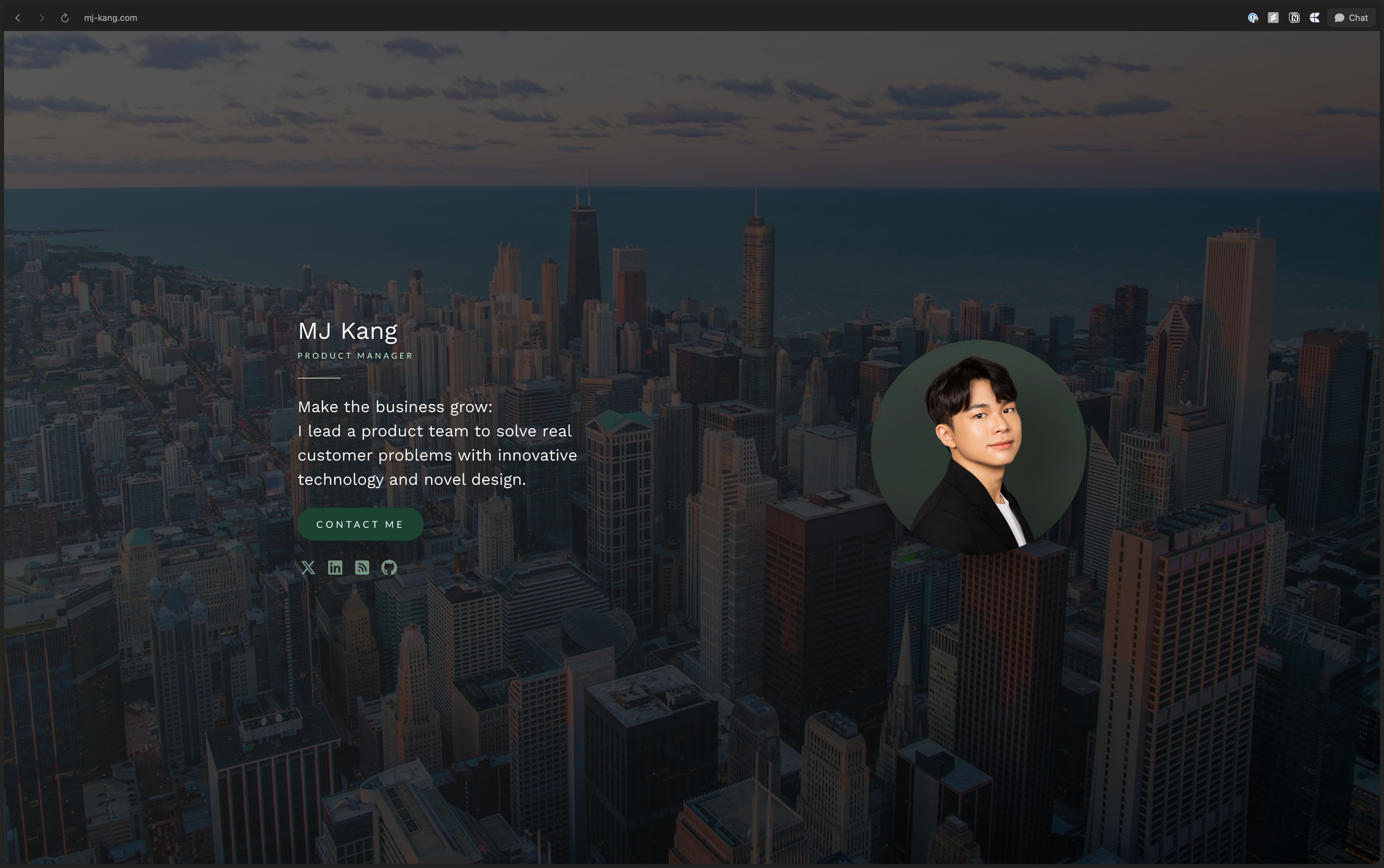
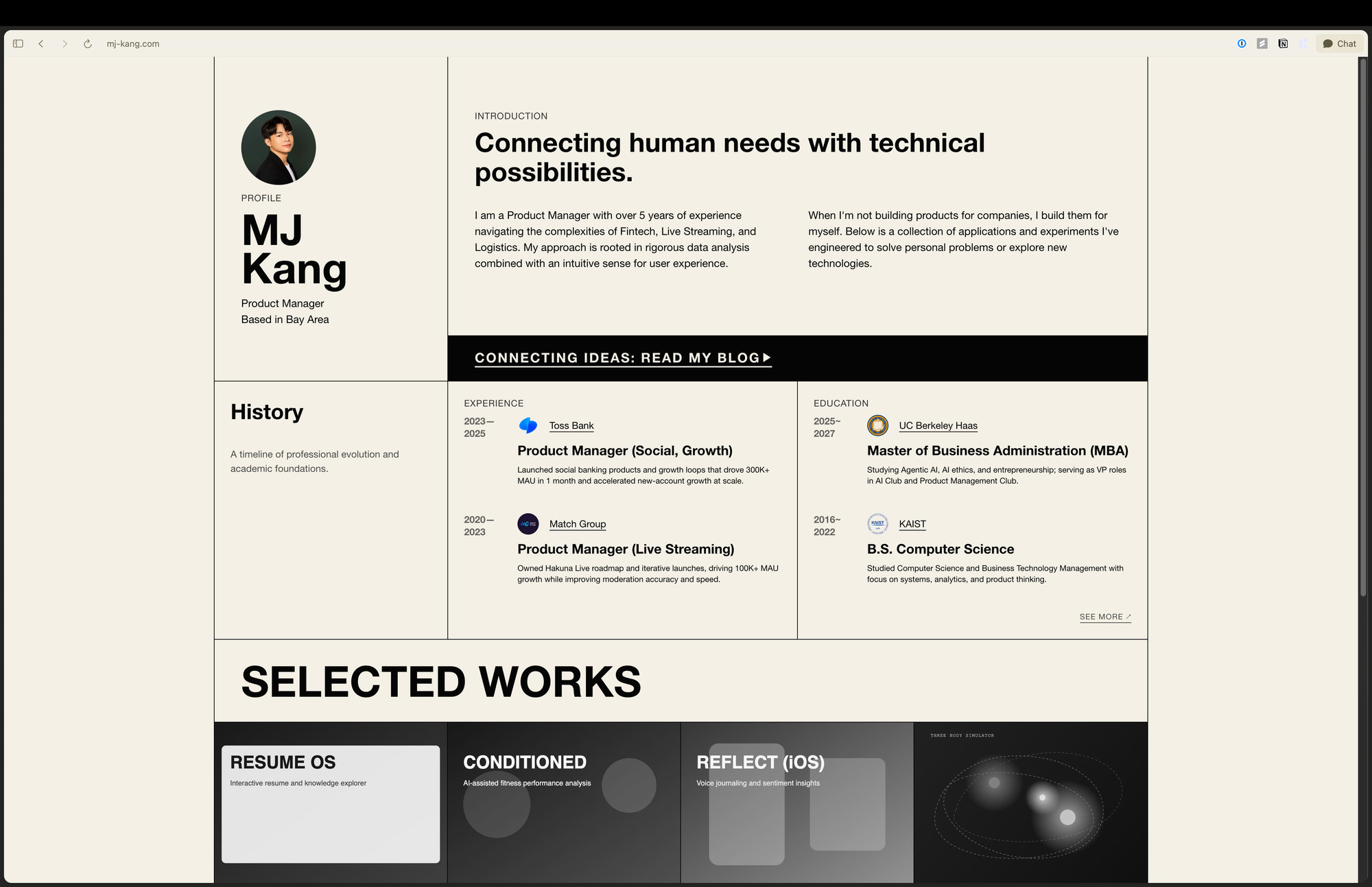
Before / After
It looks like a design task, but the harder work was decision-making:
- Should I prioritize projects or career?
- Who is my audience, builders, recruiters, founders, friends, or myself?
- Do I want to look credible, interesting, approachable, or sharp?
- Do I optimize for scanning or deep exploration?
- What do I want someone to feel after 10 seconds?
Branding, information architecture, writing tone, structure, sequencing, and defaults are all taste. The visual layer is just the visible evidence of those decisions.
Another example from building: When I made Resume OS, I chose to auto-click a specific bullet point as part of onboarding. Without that, users might not notice the core capability because interactivity is invisible until you trigger it. That is not 'just UX.' It is a belief about human behavior and learning. It's a preference for guided discovery over pure exploration. It is taste.
In the vibe coding era, your product becomes the sum of these micro-decisions.
How To Grow Taste
Steve Jobs’ interview hints at something important: taste is not a gene. It is a habit. He talked about immersing himself in calligraphy, Bauhaus design, music, and the humanities. It is not about becoming an artist. You have to build a wide internal library of what good looks like.
Paul Graham makes it even more explicit in Taste for Makers. He says good taste comes from seeing a lot of good things, making bad things yourself, and then being able to recognize that what you made is bad. That ability to feel the gap is the beginning of taste.
I love that framing because it reframes taste as a process, not a personality trait.
Taste grows through a loop:
1) Inputs
A designer I worked with once explained why Pinterest was such a milestone in the design world. Before Pinterest, a lot of design intent had to be explained verbally, or you had to sketch it out to make your point. But once Pinterest became mainstream, it became much easier to communicate what you actually meant, not just the layout, but the mood, emotion, and feeling you wanted the work to carry.
That story stuck with me because it’s not only a design problem. There are things you can’t explain in language. Some ideas can only be expressed as a combination of similar things. You point at references and say, "More like this, less like that." You assemble meaning by proximity.
This is why taste needs an internal library. If you want better taste, you need more high-quality inputs. Not to copy, but to sharpen your ability to recognize what is good, what is derivative, what is coherent, and what is noise.
Taste grows when you have enough examples in your head to make comparisons quickly and precisely.
2) Outputs
Inputs build your internal library. Outputs convert that library into judgment.
This is where taste becomes real. When you make something, you can’t avoid trade-offs. Do you optimize for clarity or density? Guided or exploratory? Strong defaults or neutral ones? Polished or shipped? Those choices expose your preferences.
Vibe coding makes this even more obvious because execution is cheap. You can generate five versions in an hour, but the model won’t tell you which one is better. If you can’t articulate 'why this,' you’re not practicing taste, you’re just sampling.
The fastest way I’ve found is to treat outputs as experiments. Ship something small, then notice what you instinctively want to change. That gap between intention and result, sometimes even the mild embarrassment, is useful. It’s your taste showing up.
3) Feedback and calibration
Taste is yours, but if your goal is to serve real people, you need friction from reality. Not to dilute your taste, but to make it legible and effective.
I spend time around geeky builders. In that bubble, people debate model choices, agent workflows, Claude vs ChatGPT, and so on. Then you talk to normal users and realize many only know ChatGPT, and some do not even care what the tool is called. Their baseline knowledge is different. Their motivation is different. Their patience is different.
Your taste isn’t wrong. It’s just calibrated for a specific environment.
If your goal is a niche audience, being opinionated is a superpower. You can design purely for the people who share your instincts and references.
If your goal is distribution, taste has to interact with feedback. You still need a point of view, but it has to survive contact with people who don’t think like you.
Taste without calibration becomes a private aesthetic. Calibration without taste becomes generic.
Over time, this loop changes your behavior. You start cutting faster. You start discarding earlier. You start noticing “this is not it” before you invest weeks into it.
Eventually, taste becomes a filter you apply before building, not just a critique after shipping.
Conclusion
We are entering an era where anyone can make a lot.
So the differentiator might not be how much you can produce.
It might be how much you can discard.
Building is becoming abundant. Editing is becoming the craft.
If you want to grow taste, make more, but also throw away more. Be harsher with your defaults. Be more honest about what is noise. Be willing to delete things you worked hard on.
Taste is not just "what you like." It's the discipline of deciding what should exist.
And in the vibe coding era, that is the new core skill.

MJ Kang Newsletter
Join the newsletter to receive the latest updates in your inbox.